
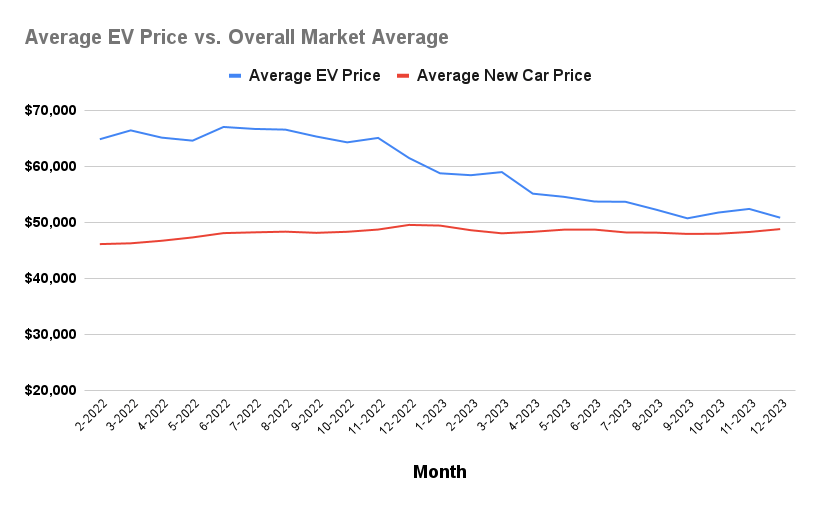
Image Source: CarEdge.com
Inflation has a funny way of sneaking up on us. When I was working on the Volkswagen account in the early 2000s, a brand new top-of-the-line Jetta GLX was $25,000 and I thought that was crazy (I was making $37,000 a year!). To that point I hadn’t spent more than $2,500 on any car that I had owned. I know, that was 20 years ago, but check this out.
Last year the average price of a new car was $47,010 and it actually peaked above $48,000. To put your shock into context, the average new car cost only $34,450 in 2016. That’s a 36% increase in just seven years. There are a few reasons for this, including pandemic-induced inflation, the cost to add new in-demand features and the demise of inexpensive cars at the bottom of the market due to a change in how the Corporate Average Fuel Economy (CAFE) standards are calculated, which dis-incentivized manufacturers to make small cars. And, collectively, Americans have been willing to pay higher prices for bigger and safer vehicles with the latest tech.
So how does the cost of the average ICE car compare to the average EV? Well, EVs have an earned reputation for being expensive, but with the price of new cars already quite high and a combination of intense competition and rebates, the disparity is not as great as you might think and in some cases EVs are about the same. The chart above shows the convergence.
Before I get into the detail of EVs versus ICE pricing, I’ll cut to the chase on the important points:
- Federal incentives can reduce the price of a new EV by as much as $7,500.
- State incentives vary wildly from none to $3,500 in Massachusetts and $6,000 in Colorado.
- EV competition has been intense in 2024 with manufacturer and dealer incentives never seen before. Pricing has changed frequently in favor of consumers.
- This article looks at Manufacturer’s Suggested Retail Price (MSRP) because it is a simpler way of comparing pricing, but lease deals are plentiful right now and if you prefer that route, you can use base MSRP as a starting point for shopping, then explore special lease offers.
- There has never been a better time to buy an EV.
The New EV Landscape
There are nearly 60 EVs available for sale in the U.S. If that’s more than you thought, it’s partly because the top 10 vehicles have 73% of the market, with the Tesla Model Y leading with a 39.3% share, followed by the Model 3 with 11.9%. However, Tesla’s share is eroding as competitors offer aggressive incentives and the shine on Elon Musk wears off with each new Tweet. Nearly every manufacturer has introduced and currently sells an EV because of market and strategic imperatives that are forcing their hands to develop and sell EVs on the promise of an electrified future. All that effort, plus federal and state incentives mean consumers have a lot of options at competitive prices.
To get you oriented on the cost of popular EVs, here’s a list of the Top 10 EVs sold in Q1, 2024 with their base MSRP.
| Rank | Brand/Model | Share | Base MSRP |
| 1. | Tesla Model Y | 39.3% | $46,630 |
| 2. | Tesla Model 3 | 11.9% | $44,130 |
| 3. | Tesla Model X | 3.7% | $79,990 |
| 4. | Rivian R1S | 3% | $75,900 |
| 5. | Volkswagen ID.4 | 3% | $39,735 |
| 6. | Ford Mustang Mach-E | 2.9% | $39,995 |
| 7. | Chevrolet Bolt (discontinued) | 2.6% | $26,500 |
| 8. | Ford F150 Lightning | 2.4% | $62,995 |
| 9. | Hyundai Ioniq 5 | 2.3% | $37,500 |
| 10. | Cadillac Lyriq | 2.1% | $58,590 |
The table above tells us a few things. First, the volume leaders from Tesla are competitively priced against the new car market, in general. It’s one reason they have the top two spots. Second, Tesla isn’t the only strong offering in the $40K range. And third, a good portion of the market is targeted to luxury buyers. The Tesla Model X, Rivian R1S and new Cadillac Lyriq cost considerably more.
For comparison, here are the Top 10 11 vehicles sold in the U.S. through July with their base MSRPs.
| Rank | Brand/Model | Base MSRP |
| 1. | Ford F150 | $38,610 |
| 2. | Chevrolet Silverado | $36,800 |
| 3. | Toyota RAV4 | $28,675 |
| 4. | Honda CR-V | $30,100 |
| 5. | Ram Pickup | $38,705 |
| 6. | Toyota Camry | $28,400 |
| 7. | GMC Sierra | $39,695 |
| 8. | Nissan Rogue | $28,850 |
| 9. | Honda Civic | $24,250 |
| 10. | Toyota Corolla | $22,050 |
| 11. | Tesla Model Y | $46,630 |
Every one of the top 10 selling cars has a base price under $40,000, but we know from the average selling price (and inventory searches) that base cars are hard to come by. There are 5 cars on the EV Top 10 under $40,000 and when you factor in Federal and State incentives you could get into a Tesla Model Y, Model 3, Volkswagen ID.4, Ford Mustang Mach E, and Hyundai Ioniq 5 for less than many ICE vehicles.
Additionally, there are smaller, short-range vehicles like the Hyundai Kona Electric ($32,675), Nissan Leaf ($28,140), and Mini Electric Hardtop ($31,895). Just higher in size and price are new entrants Chevy Equinox ($41,900) and Honda Prologue ($47,400) and cars gaining momentum, the Kia EV6 ($42,600) and Hyundai Ioniq 6 ($37,500). If you’re looking at ICE options in the $40K range, there are plenty of EVs to shop as well.
Buyer’s Resources
I’ve found TrueCar to be the best one-stop site for information about all brands of EVs. You can shop new and used, learn about each vehicle, average transaction price, and personalize incentives by where you live and income. Once you’ve narrowed your choice down to a few brands or models, check manufacturer sites for incentives. Compare what you see there to a resource like Edmunds. Dealers may or may not advertise those incentives, so get informed and use that to your advantage when negotiating.
It really has never been a better time to buy an EV. Federal rebates can be processed right at the dealership, meaning you see the savings up front and your monthly payments will reflect that. Manufacturers are getting cold feet about electrification and hedging their portfolios with hybrid vehicles, offering huge incentives on EVs to ensure they don’t pile up in inventory. And as I’ve written earlier, charging infrastructure continues to improve. I can’t wait until I can shop for my first EV.
 The Road to Electric Vehicle Adoption
Leave a comment